Find your next read
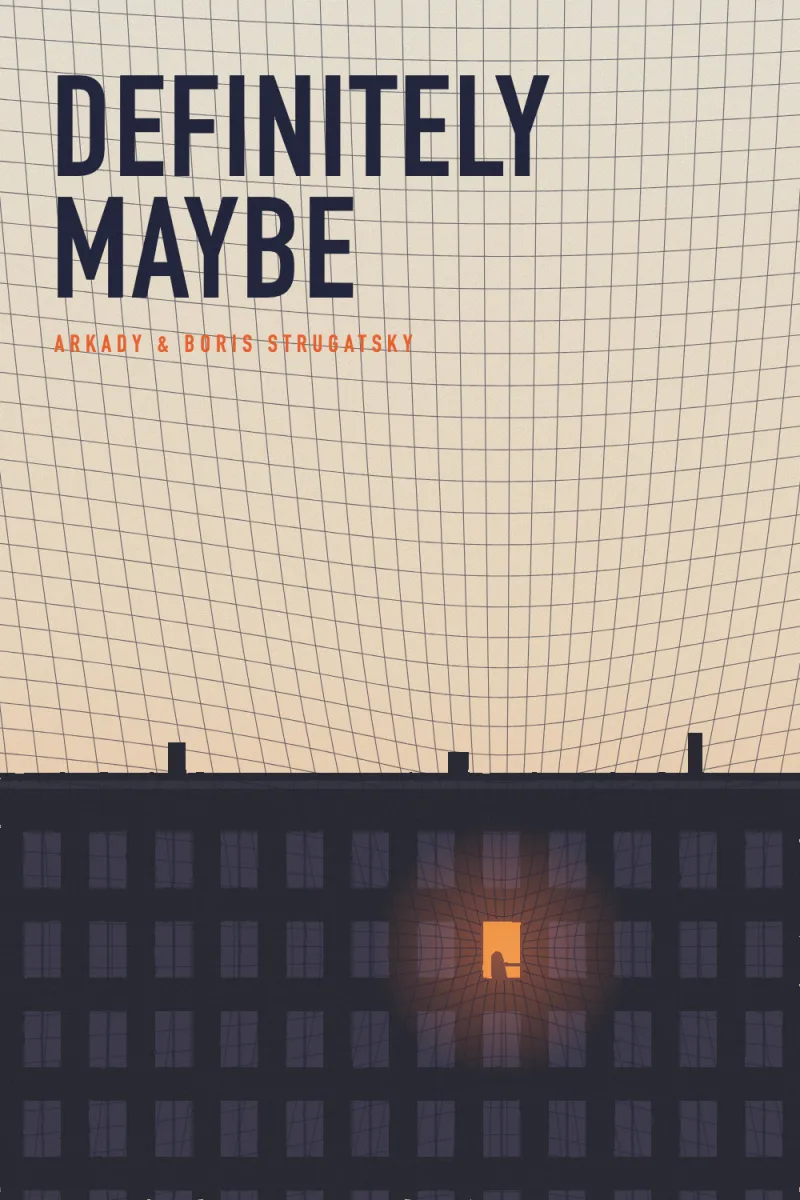
All reviews written by humansDefinitely Maybe
Your rating:
★★★★★★★★★★
Synopsis · not our opinion
Arkady and Boris Strugatsky’s Definitely Maybe (За миллиард лет до конца света) is a gripping sci-fi philosophical thriller set in a sweltering Leningrad apartment.
Astrophysicist Dmitri Malyanov is on the verge of a groundbreaking scientific discovery when mysterious, increasingly absurd disruptions begin derailing his work. As his fellow scientist neighbors face similar bizarre obstacles, they realize they are up against a sinister, unseen force. Or is it just in their heads? Tense, paranoid, and intellectually sharp - this novella is a powerful exploration of moral courage, scientific integrity, and the price of knowledge.
Literal translation: A Billion Years Before the End of the World. Published in English as Definitely Maybe: A Manuscript Discovered Under Strange Circumstances.
Reviews (2) · our opinion
N
NikolaiNovember 12, 2026
Throughout the entire book, I couldn’t shake the feeling that I was in the setting of some American horror movie about college students who are facing something paranormal and can’t make sense of it — but in a late-Soviet version, and the characters aren’t really college students at all. I think anyone who doesn’t really have a clear picture of typical life in the USSR will find the details of life in that era very interesting — to catch even a glimpse of those small, cigarette-smoke-filled yet cozy kitchens, where Soviet engineers, having finished drinking cognac with caviar, are now finishing off their tea with candies.
Everyone has a limit beyond which they are willing to fight, to be principled and unyielding, but after that — they invariably give in, bow their heads, and do whatever they’re told. We can observe something similar in Orwell’s "1984". At the same time, this limit is most often not even ideological or conscious, but lies at the level of some base biological — one might even say animalistic — fears. For example, a fear of mice or of endangering one's offspring. As in Orwell’s work, people who have been broken no longer feel fully human.
In my opinion, Definitely Maybe isn’t classic science fiction, but rather a psychological thriller. It’s gripping, forcing you to internalize all the events of the book and reflect on how you yourself would have acted in the protagonists’ shoes. Would you be able to resist the unknown pressure for the sake of what you love, and if so, for how long?
A
AliceOctober 26, 2026
I read it in a day. The world just stopped.
Definitely Maybe is a novella about a Soviet scientist on the verge of a great discovery. And all of his friends, who are close to discoveries of their own. But something -- or someone -- is clearly messing with them. All of them.
It’s a rather short one - just enjoy it, you don’t really need a big review or spoilers.
It threw me somewhere I didn’t expect. There’s something wonderfully strange about the atmosphere: you’re still surrounded by ordinary life but you no longer quite trust it. The familiar starts to feel suspicious. You keep reading hoping to get your bearings.
And so much of it felt familiar from the post-Soviet Russia I grew up in. If you are a millennial or older, you know what i mean. Little details, conversations, the texture of everyday life: things I recognized before I even thought to name them. There was something unexpectedly cozy about it, like looking through photographs from the 80-s and 90-s, all faded colors and a faint sepia tint. Not because everything was wonderful then. Just because I knew that world... and for a moment it felt close enough to touch.
What I liked was how much space there is for uncertainty. I didn’t need everything explained immediately. I wanted to stay inside that peculiar feeling, let it get stranger, see how far it would go. Sometimes not quite understanding is a pleasure in itself, provided you trust the people doing this to you.
And I did.
I liked it. I could try to make that sound more sophisticated but really: it leaves you somewhere slightly different from where it found you. And that’s already a lot.