Find your next read
All reviews written by humansThe Three-Body Problem
Your rating:
★★★★★★★★★★
Synopsis · not our opinion
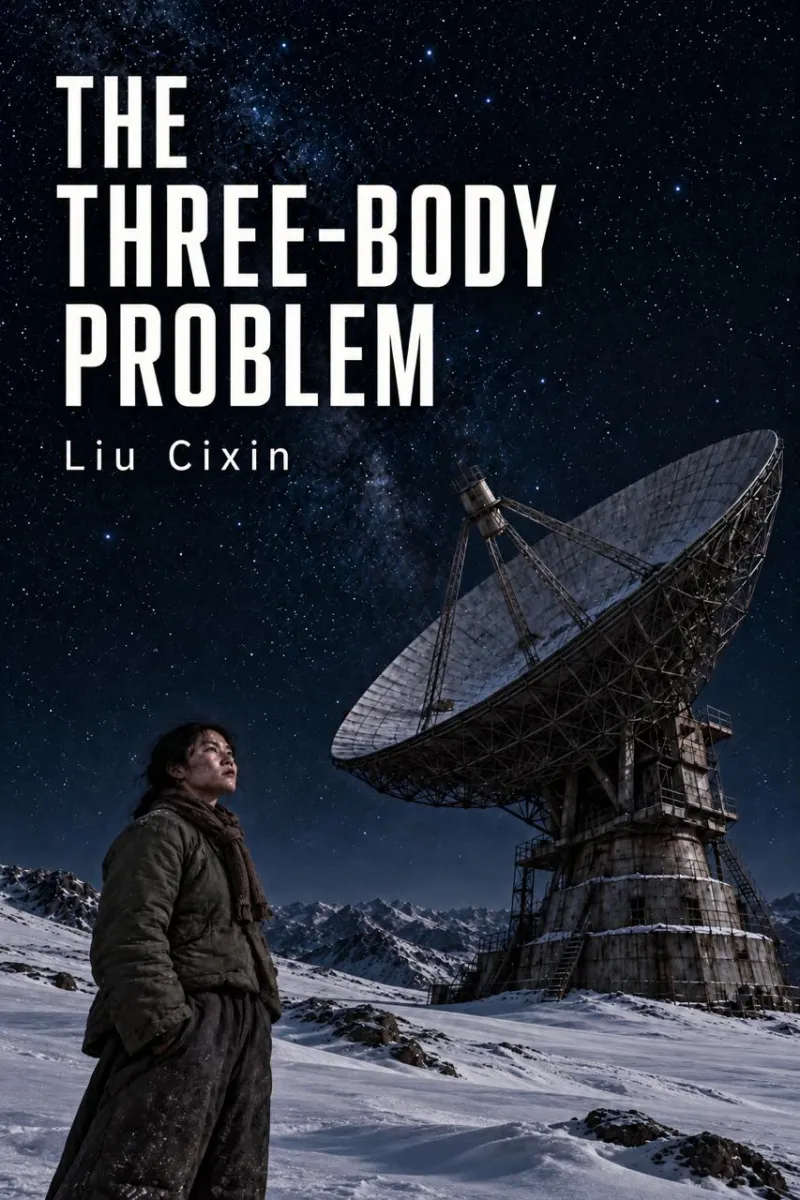
The Three-Body Problem is the Hugo Award-winning hard sci-fi phenomenon that begins amid the chaos of China’s Cultural Revolution, when a disillusioned young astrophysicist sends a desperate signal into deep space. Decades later, the consequences begin to unfold in unimaginable ways. As a wave of mysterious suicides sweeps through the scientific community and a bizarre virtual reality game hints at a terrifying truth, humanity must confront an existential threat. A mind-bending, epic thriller that redefines the alien invasion trope through brilliant physics and chilling cosmic philosophy.
Reviews (2) · our opinion
A
AliceOctober 16, 2026
Close your eyes. Open your eyes. You see a countdown. But only if what you’re doing matters to the world. It can even follow you into your dreams. What happens when it reaches zero?
Once, a young girl found herself at the heart of a theater of the absurd: a “cultural revolution” sweeping away every trace of culture in its path, science twisting the truth to serve ideology and human cruelty - senseless, sickening, leaving wounds that would never heal.
Once, a young girl killed all of humanity in a single act. Not right then, but sometime in the future.
Once, a young girl punished a world so barbaric that she no longer wanted to save it.
What punishment does someone deserve for doing the unthinkable?
If I could take the same journey twice, I would choose to forget *The Three-Body Problem* entirely, just to experience it all over again.
Because at first, you have no idea what kind of story you’re being told.
China during the Cultural Revolution. Scientists taking their own lives, one after another. A strange computer game where civilizations rise and fall, over and over again. Numbers appearing before the eyes of someone who has strayed too close to an invisible boundary.
And then, slowly, it all comes together into one breathtaking yet utterly monstrous story with an atmosphere unlike any other. A story with no main characters, yet one in which every character takes center stage. A story that makes you understand someone you don’t want to understand.
The time I spent with this book is priceless. And this is the book that makes you realize just how precious our time really is.
N
NikolaiAugust 3, 2026
“Remembrance of Earth's Past” is one of the best science fiction trilogies I've ever read. It's well-crafted, with no gaffes or errors.
First of all, this is the first book of its kind by an Asian author that I’ve read. It’s no secret that Asia has a worldview—and a perspective on life and its value—that differs from Europe’s; people there feel things differently, and it’s fascinating to get a glimpse of all that and try to understand it. How can a person be both a cog in the vast machine of China during the Cultural Revolution and, at the same time, try to remain true to their inner ideals, carry them through their entire life, and put them above all else?
Second, I was drawn to the scientific aspect of "The Three-Body Problem" — the problem itself, which the brightest minds on our planet grapple with throughout the book. Liu Cixin explains the necessary laws of physics in a clear and engaging way, so the barrier to entry for understanding the characters’ line of reasoning is quite low, and in between reading sessions, you can’t help but wonder what was actually happening in the book’s simulator. The solution, however, is not at all disappointing; rather, it delights and even frightens a little.